Preschool guide · Singapore
Is Preschool Free in Singapore? What Parents Pay in 2026, 2027 and by 2030
No, preschool is not free in Singapore in 2026, and it will not be free in 2027. Fee caps and subsidies bring full-day childcare at an Anchor Operator down to about S$365 a month for a working family, and to as little as S$3 for the lowest-income families. This guide covers what parents pay today, the changes coming in 2027 and by 2030, and why preschool costs money at all.
For short answers to 32 common questions, see the preschool in Singapore FAQ.
Is preschool free in Singapore?#
No, preschool is not free in Singapore, but subsidies cut the cost a lot for Singapore Citizen children. These are the four things that set what a family pays in 2026:
- Fee caps: full-day childcare costs at most S$610 a month at Anchor Operators and S$650 at Partner Operators, before GST.
- Basic Subsidy: up to S$300 a month for full-day childcare and S$600 for full-day infant care, if the main applicant works at least 56 hours a month. Otherwise it is S$150.
- Additional Subsidy: extra help for working families with a household income of S$12,000 a month or less, rising to S$15,000 from 1 January 2027.
- Kindergarten fees: MOE Kindergartens cost S$160 a month for citizens. The Kindergarten Fee Assistance Scheme (KiFAS) lowers this for eligible families.
Additional Subsidy for full-day childcare in 2026#
| Gross monthly household income | Additional Subsidy, up to | Minimum you still pay |
|---|---|---|
| S$3,000 and below | S$467 | S$3 |
| S$3,001 to S$4,500 | S$440 | S$25 |
| S$4,501 to S$6,000 | S$340 | S$58 |
| S$6,001 to S$7,500 | S$260 | S$104 |
| S$7,501 to S$9,000 | S$190 | S$162 |
| S$9,001 to S$10,500 | S$130 | S$232 |
| S$10,501 to S$12,000 | S$80 | S$315 |
These bands apply from 1 January 2026 and are added on top of the S$300 Basic Subsidy. From 1 January 2027 the same amounts apply to higher incomes, up to S$15,000: see the new income bands.
Full guide: infant care and childcare subsidy in Singapore, explained, with how the subsidy is calculated.
Where is preschool free? No preschool in Singapore is free for every family. Some other places offer free public preschool, such as California's transitional kindergarten for all 4-year-olds.
Sources: MSF COS 2026 (opens in a new tab), ECDA eligibility (opens in a new tab), ECDA subsidy table (opens in a new tab), ECDA KiFAS (opens in a new tab), MOE fees (opens in a new tab), TK California (opens in a new tab)
How much does preschool cost in Singapore?#
Full-day childcare in Singapore costs from about S$600 to over S$4,000 a month before subsidy, and the type of operator matters most. Published monthly fees for a Singapore Citizen child in 2026:
| Type of preschool | Full-day childcare | Full-day infant care |
|---|---|---|
| Anchor Operator | S$610 cap | S$1,235 cap |
| Partner Operator | S$650 cap | S$1,290 cap |
| Private (no government scheme) | median S$1,750, range S$640 to S$4,390 | no cap |
| MOE Kindergarten, half day (K1–K2) | S$160 | not offered |
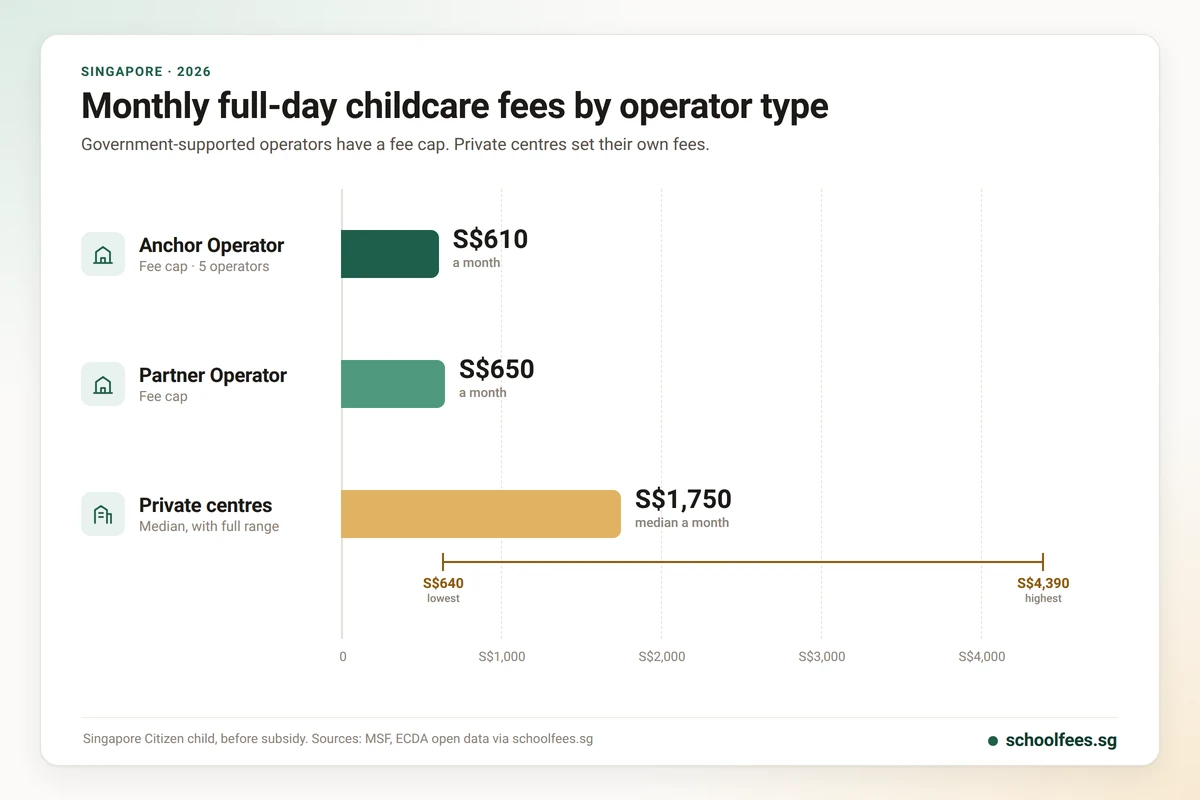
After the S$300 Basic Subsidy, a working family pays about S$365 a month (including GST) at an Anchor Operator and about S$409 at a Partner Operator.
Preschool fees for foreigners and PRs are higher. Non-citizens get no subsidy, and many centres charge them more. The median full-day nursery fee is S$650 for citizens, S$1,050 for permanent residents and S$1,188 for foreigners. MOE Kindergarten costs S$320 a month for permanent residents.
Budget for one-time costs too. These include a refundable deposit, registration, insurance and uniforms, and they add about 10% to the first year.
To see what one centre really costs, search your postal code on schoolfees.sg. Each centre page shows the published fee, the fee after subsidy for every income band, and the first-month total.
Sources: MSF COS 2026 (opens in a new tab), MOE fees (opens in a new tab), Yahoo News on NDR 2026 (opens in a new tab). Private and citizenship medians come from schoolfees.sg's reading of ECDA open data (2026).
Will preschool be free in 2026 or 2027?#
No. Preschool in Singapore is not free in 2026 and will not be free in 2027. Instead, fees are falling and help is widening in three steps:
| When | Change |
|---|---|
| 2028 to 2030 | Full-day childcare fees at government-supported preschools fall to S$150 a month and infant care to S$300, before income-based subsidies. Full subsidies will also be extended to all families with citizen children, whether or not the applicant works; the timing is still to be announced. Details are due in early 2027. |
| 1 January 2027 | The income ceiling for Additional Subsidy and KiFAS rises from S$12,000 to S$15,000 a month. More than 60,000 more families qualify. See what changes in 2027. |
| 1 January 2026 | Full-day childcare fee caps fall to S$610 (Anchor Operators) and S$650 (Partner Operators). |
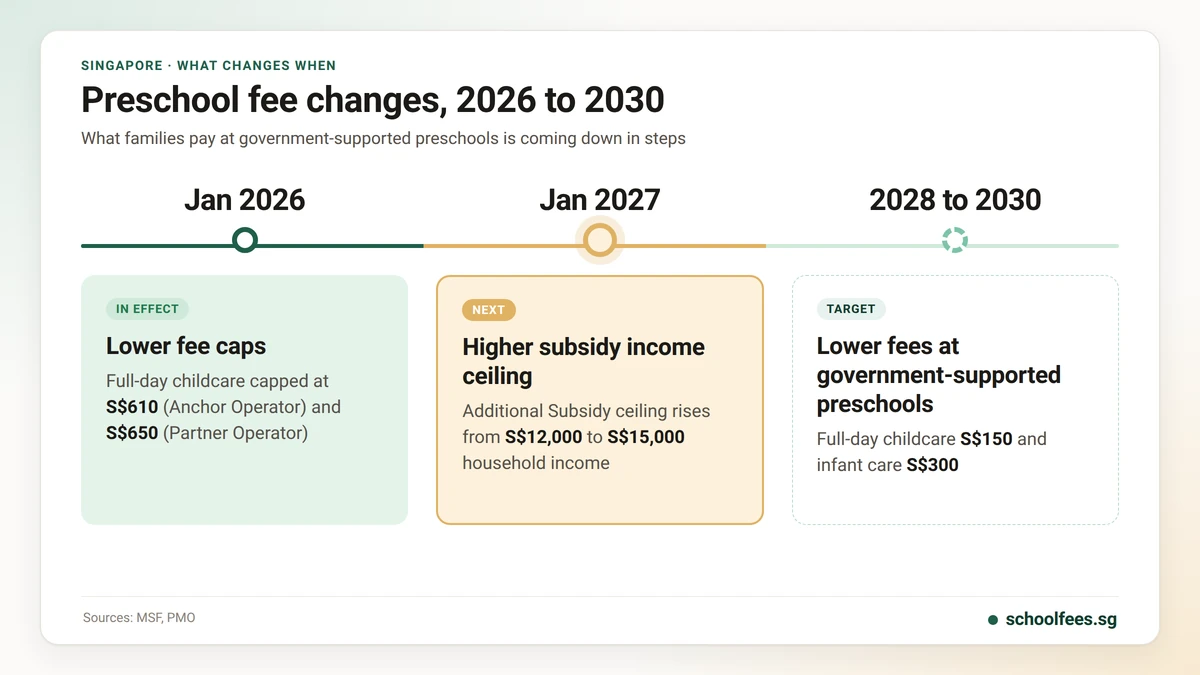
Even after 2030, most families will still pay a monthly fee, and lower-income families will pay less. The S$150 figure is less than half of the S$365 a working family pays at an Anchor Operator today.
Sources: Made For Families (NDR 2026) (opens in a new tab), MSF COS 2026 (opens in a new tab), Her World (opens in a new tab)
Why does preschool cost money?#
Preschool in Singapore costs money mainly because it needs many trained staff for long hours. ECDA sets minimum staff-to-child ratios: one qualified educator for every 5 infants, 8 playgroup children, 12 N1 children, 15 N2 children, 20 K1 children and 25 K2 children. Full-day centres also open 12 hours a day, serve meals and pay rent.
The government already pays a large share. Its yearly spending on early childhood grew from S$1 billion in 2018 to S$1.8 billion in 2021, and it was expected to double. Fee caps and subsidies come from this spending, and parents pay the rest. Teacher qualifications are explained in what to expect at preschool.
Sources: ECDA ratios (opens in a new tab), MSF (opens in a new tab)
Did preschool use to be free in Singapore?#
No. Preschool in Singapore has never been free for everyone. Even the first crèches after World War II charged about 10 cents a day, and kindergartens were mostly run by churches, community groups and private operators that charged fees.
What has changed is how much the government pays:
- The Anchor Operator fee cap for full-day childcare fell from S$720 in 2022 to S$610 in 2026.
- A median-income family at an Anchor Operator spent 3.1% of household income on full-day childcare in 2023, down from 4.9% in 2018.
For the full history, see when preschool started in Singapore.
Sources: National Archives (opens in a new tab), IJCCEP (2017) (opens in a new tab), MSF (opens in a new tab)
Does preschool count as dependent care?#
"Dependent care" is a US tax term, and Singapore has no tax deduction for preschool fees. Singapore helps families in other ways:
- Preschool subsidies, paid straight to the centre to lower the monthly fee.
- Child Development Account (CDA): Baby Bonus savings that can pay preschool fees, deposits and registration fees at approved centres.
- Tax reliefs for parents that do not depend on childcare spending. For example, Working Mother's Child Relief is S$8,000, S$10,000, or S$12,000 for the first, second, and third or later child born on or after 1 January 2024.
Sources: MSF on CDA (opens in a new tab), Made For Families tax reliefs (opens in a new tab)
Summary#
- Preschool is not free in Singapore in 2026 or 2027, but subsidies cut full-day childcare to about S$365 a month for working families at Anchor Operators, and to S$3 for the lowest incomes.
- From 1 January 2027, families earning up to S$15,000 a month can get Additional Subsidy.
- By 2030, full-day childcare at government-supported preschools is planned to cost S$150 a month before income-based subsidies.
- Non-citizens get no subsidy and often pay higher fees.
How we check this guide#
Every figure on this page links to the government page it came from, shown under each answer. The guide was last checked against those sources on . We re-check it whenever ECDA, MOE or MSF announces a change, and at least every 90 days.