Preschool guide · Singapore
Is Preschool Necessary? What It Does for Learning, Behaviour and Speech
Preschool is not required in Singapore, and a child can start Primary 1 without it, yet more than 9 in 10 children attend. Research shows that the benefits depend on the quality of the programme and on what a child already gets at home. This guide sets out both sides, then explains how preschool helps with Primary 1, behaviour and speech.
For short answers to 32 common questions, see the preschool in Singapore FAQ.
Is preschool necessary?#
Preschool is not legally necessary in Singapore, because compulsory education starts at Primary 1. Whether it is necessary for your child depends on what they get at home.
Why it may not be necessary: a home with plenty of talking, reading, play and time with other children gives many of the same benefits. An OECD study found that the score gap between children who did and did not attend preschool almost disappears once family background is taken into account.
Why many families see it as necessary:
- More than 9 in 10 children in Singapore attend, so most Primary 1 classmates will already know classroom routines.
- Preschool gives daily practice in a Mother Tongue language.
- Children with developmental needs can get support inside their preschool.
If your child stays home, plan regular time with other children and some group routines before Primary 1. For the legal side, see is preschool compulsory in Singapore.
Sources: OECD (opens in a new tab), NIE citing MSF (opens in a new tab), ECDA DS-LS (opens in a new tab)
Why is preschool important for a child?#
Preschool gives children daily chances to play, talk and learn with trained teachers and other children, which builds the skills they use in Primary 1. Singapore's Nurturing Early Learners (NEL) framework for ages 4 to 6 covers five learning areas:
- Aesthetics and creative expression
- Discovery of the world
- Health, safety and motor skills
- Language and literacy, in English and Mother Tongue
- Numeracy
It also teaches values and social skills, such as taking turns and managing feelings.
Quality matters more than attendance alone. The OECD found that better-quality programmes were linked to stronger skills at age 15, while simply attending was not enough. To judge quality, use the checks in how to choose the best preschool in Singapore.
Sources: NEL Framework 2022 (opens in a new tab), OECD (opens in a new tab)
Does preschool help prepare for Primary 1?#
Yes. In Singapore, kindergarten (K1 and K2) is itself part of preschool, so the big step it prepares for is Primary 1. Preschool builds early reading and counting in English and Mother Tongue, and school habits such as group time and following instructions. The NEL framework is designed to support this move to primary school.
Singapore's SKIP study, which followed about 1,500 children from K1 onwards, found that early self-control and fine motor skills predicted reading and maths in late primary school.
In the US, pre-K plays the same role before kindergarten, which there is the first year of primary school.
Sources: NEL Framework 2022 (opens in a new tab), NIE SingTeach on SKIP (opens in a new tab)
Will preschool help my child's behaviour?#
Often, yes, over time. Preschool gives children daily practice in sharing, waiting, following routines and naming their feelings, and Singapore's NEL framework teaches these social and emotional skills on purpose. Many children cry or cling more in the first weeks, which is a normal part of settling in.
If behaviour worries last, talk to the teachers. Children in K1 and K2 can get help inside their preschool through ECDA's Development Support–Learning Support (DS-LS) programme, which covers behaviour and social skills. Fees start from S$5 and depend on household income.
Sources: NEL Framework 2022 (opens in a new tab), ECDA DS-LS (opens in a new tab)
Will preschool help my child talk?#
Preschool can help, because children hear and use language all day with teachers and classmates, and Singapore preschools teach both English and a Mother Tongue language. But preschool is not a treatment for a speech delay.
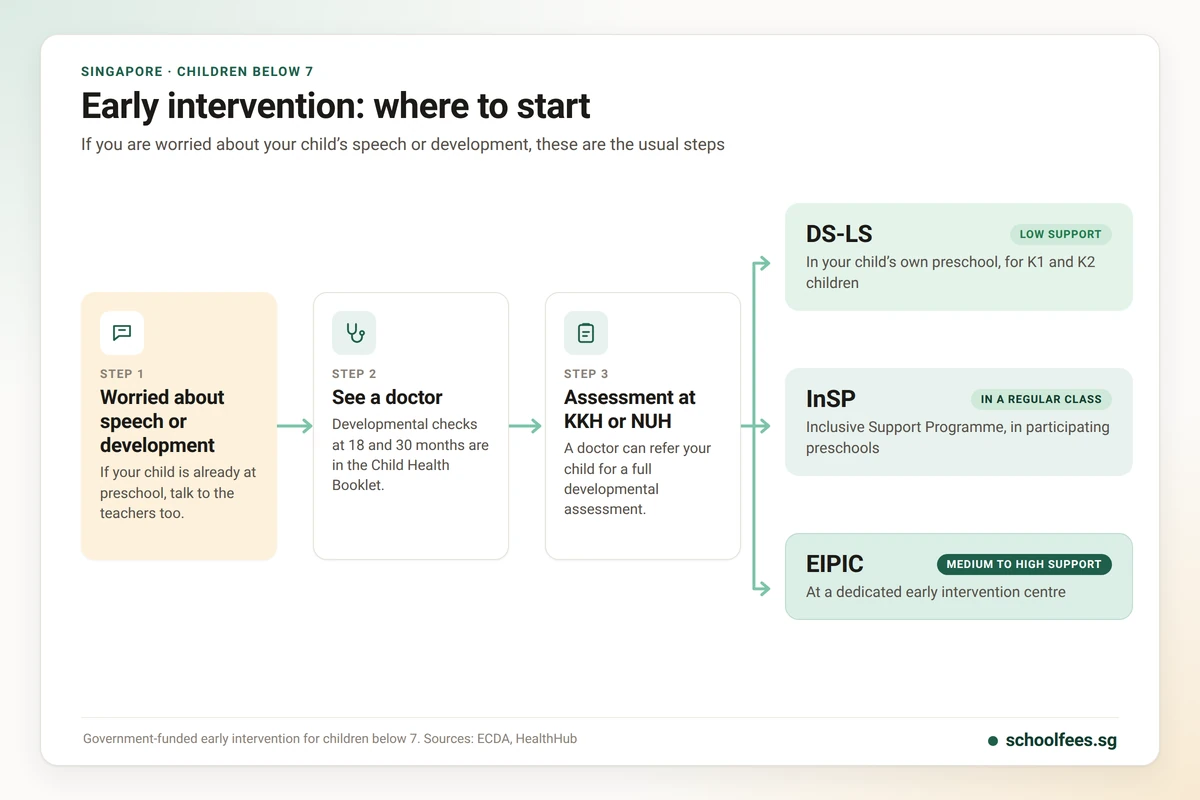
If you are worried about your child's speech, see a doctor. Singapore's Child Health Booklet lists development checks at 18 months and 30 months, among others, and a doctor can refer your child to KKH or NUH for a full assessment. Children below 7 can get government-funded early intervention:
| Programme | Who it is for | Where |
|---|---|---|
| Development Support–Learning Support (DS-LS) | K1 and K2 children who need low support, including speech and language | Inside the child's preschool |
| Inclusive Support Programme (InSP) | Children with developmental needs in a regular class | Inside participating preschools |
| Early Intervention Programme for Infants and Children (EIPIC) | Children who need medium to high support | At a dedicated centre |
Sources: HealthHub Child Health Booklet (opens in a new tab), ECDA early intervention (opens in a new tab), ECDA DS-LS (opens in a new tab)
Summary#
- Preschool is not required in Singapore, but more than 9 in 10 children attend before Primary 1.
- Benefits depend on programme quality and on the learning a child already gets at home.
- Preschool builds language, numeracy and social skills for Primary 1, following the NEL framework.
- Preschool can help speech, but it is not a treatment for speech delay; see a doctor and ask about early intervention.
How we check this guide#
Every figure on this page links to the government page it came from, shown under each answer. The guide was last checked against those sources on . We re-check it whenever ECDA, MOE or MSF announces a change, and at least every 90 days.