Preschool subsidies · Singapore
Infant Care and Childcare Subsidy in Singapore: 2026 Rates and 2027 Changes
Every Singapore Citizen child in an ECDA-licensed infant care or childcare programme gets a monthly subsidy under ECDA's Infant and Childcare Subsidy Scheme. The Basic Subsidy is S$600 for full-day infant care or S$300 for full-day childcare when the mother works, and S$150 when she does not. Working families earning S$12,000 a month or less also get an Additional Subsidy of up to S$710 or S$467, and from 1 January 2027 that income limit rises to S$15,000.
- Full-day childcare at an Anchor Operator after the Basic Subsidy
- S$364.90
- S$610 fee cap plus GST, less S$300
- The lowest monthly bill for full-day childcare
- S$3
- Household income S$3,000 or less
- More families get help from 1 January 2027
- 60,000+
- MSF estimate
Rates shown: from Next change: — the income limit rises to S$15,000
To see the figure for one centre, search your postal code: every centre page on schoolfees.sg works out the fee after subsidy for all eight income bands.
How much childcare subsidy will I get?#
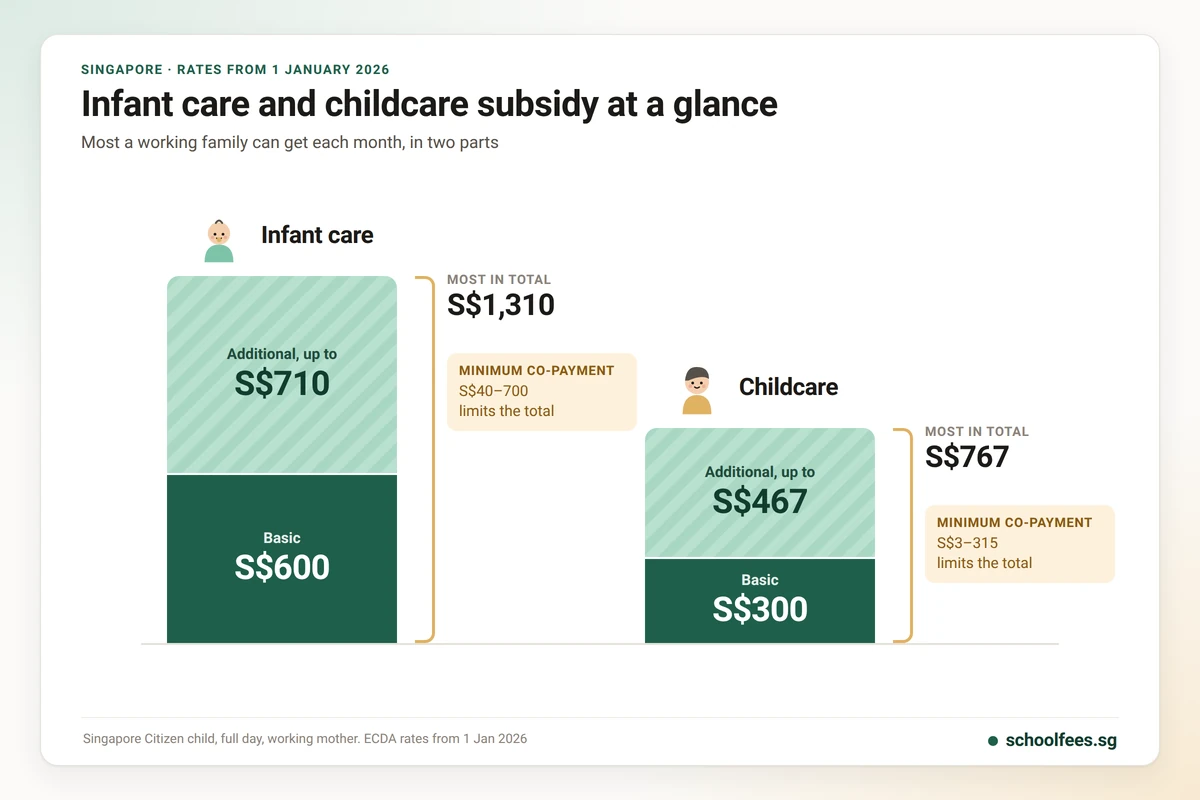
A Singapore Citizen child can get up to S$1,310 a month for full-day infant care and up to S$767 for full-day childcare. The subsidy has two parts:
| Part | Full-day infant care | Full-day childcare |
|---|---|---|
| Basic Subsidy, mother working | S$600 | S$300 |
| Basic Subsidy, mother not working | S$150 | S$150 |
| Additional Subsidy, up to | S$710 | S$467 |
| Most in total | S$1,310 | S$767 |
The Basic Subsidy depends on the working requirement and the Additional Subsidy on household income. Most families get less than the maximum, because the Additional Subsidy falls as income rises and every family pays a minimum co-payment. Half-day programmes get smaller amounts.
Sources: ECDA subsidy overview (opens in a new tab), Made For Families (opens in a new tab)
Who qualifies for childcare subsidy?#
A child qualifies for the Basic Subsidy by being a Singapore Citizen enrolled in an ECDA-licensed infant care or childcare programme. The higher Basic rate also needs the main applicant to be working, and the Additional Subsidy needs that plus a gross monthly household income of S$12,000 or less, or a per capita income of S$3,000 or less for a household of five or more family members at the same address. Both income limits rise on 1 January 2027.
What is the 56-hour working requirement?#
The working requirement means the main applicant must work at least 56 hours a month, about 13 hours a week, in full-time, part-time or freelance work. The main applicant is the mother, or the single father after a divorce, separation or the mother's death. If you do not meet the working requirement, you may still qualify for subsidies under these two categories:
- Lower-Income Childcare Families: Families earning S$6,000 a month or less have received full childcare subsidies since 9 December 2024, whether or not anyone works. Please note that this does not apply to infant care.
- Special Approval: Families with Special Approval such as individuals currently looking for a job, studying or pregnant.
What is the Basic Subsidy?#
The Basic Subsidy is a flat monthly amount that does not depend on income, only on the programme and the working requirement. For full-day programmes it is S$600 (infant care) or S$300 (childcare) when the main applicant works, and S$150 when not. Half-day programmes get S$300 (infant care) or S$150 (childcare) when the main applicant works, and S$150 when not.
What is the Additional Subsidy?#
Working families can receive an income-tested Additional Subsidy on top of their Basic Subsidy. It has seven income bands: the lower the household income, the larger the top-up and the smaller the minimum co-payment. Your income is automatically verified by ECDA via government records during application.
Note: The rates below apply until 31 December 2026. Starting 1 January 2027, thresholds will increase to cover higher incomes (see the new income bands).
| Household income a month | Per capita, 5+ people | Additional, up to | Min. co-payment |
|---|---|---|---|
| S$3,000 or below | S$750 or below | S$710 | S$40 |
| S$3,001 – 4,500 | S$751 – 1,125 | S$640 | S$110 |
| S$4,501 – 6,000 | S$1,126 – 1,500 | S$500 | S$250 |
| S$6,001 – 7,500 | S$1,501 – 1,875 | S$380 | S$360 |
| S$7,501 – 9,000 | S$1,876 – 2,250 | S$240 | S$500 |
| S$9,001 – 10,500 | S$2,251 – 2,625 | S$100 | S$640 |
| S$10,501 – 12,000 | S$2,626 – 3,000 | S$40 | S$700 |
| Above S$12,000 | Above S$3,000 | none (Basic only) | — |
| Household income a month | Per capita, 5+ people | Additional, up to | Min. co-payment |
|---|---|---|---|
| S$3,000 or below | S$750 or below | S$467 | S$3 |
| S$3,001 – 4,500 | S$751 – 1,125 | S$440 | S$25 |
| S$4,501 – 6,000 | S$1,126 – 1,500 | S$340 | S$58 |
| S$6,001 – 7,500 | S$1,501 – 1,875 | S$260 | S$104 |
| S$7,501 – 9,000 | S$1,876 – 2,250 | S$190 | S$162 |
| S$9,001 – 10,500 | S$2,251 – 2,625 | S$130 | S$232 |
| S$10,501 – 12,000 | S$2,626 – 3,000 | S$80 | S$315 |
| Above S$12,000 | Above S$3,000 | none (Basic only) | — |
What is the minimum co-payment?#
The minimum co-payment is the least a family must pay each month, however large its subsidy: S$3 to S$315 for full-day childcare and S$40 to S$700 for full-day infant care, rising with income. When the Basic and full Additional Subsidy together would take the bill below it, ECDA cuts the Additional Subsidy so the family pays exactly the co-payment. In ECDA's own example, a S$740 childcare fee in the lowest band gets S$737 of subsidy, not the S$767 maximum.
Full answer: why your Additional Subsidy can be less than the maximum
What does infant care cost after subsidy?#
At an Anchor Operator, where full-day infant care is capped at S$1,235 before GST (S$1,346.15 with GST), a working family pays between S$40 and S$746.15 a month after subsidy. Infant care gets larger subsidies than childcare, but its co-payments are also much higher, and its rates have not changed since 1 January 2023.
| Household income a month | Basic | Additional | You pay |
|---|---|---|---|
| S$3,000 or below | S$600 | S$706.15cut from S$710 | S$40 |
| S$3,001 – 4,500 | S$600 | S$636.15cut from S$640 | S$110 |
| S$4,501 – 6,000 | S$600 | S$496.15cut from S$500 | S$250 |
| S$6,001 – 7,500 | S$600 | S$380 | S$366.15 |
| S$7,501 – 9,000 | S$600 | S$240 | S$506.15 |
| S$9,001 – 10,500 | S$600 | S$100 | S$646.15 |
| S$10,501 – 12,000 | S$600 | S$40 | S$706.15 |
| Above S$12,000 | S$600 | none | S$746.15 |
Where the Additional Subsidy is cut, the minimum co-payment for that income band is what limits it: the family pays exactly the co-payment. Why this happens.
Sources: ECDA subsidy tables (opens in a new tab), MSF COS 2026 (opens in a new tab)
Can I get the full subsidy if I am not working?#
Yes: Special Approval from ECDA gives a non-working main applicant the full childcare or infant care subsidy for a limited time, when the main applicant is:
- looking for a job
- studying, training or on a course for at least 56 hours a month
- pregnant
- medically unfit for work because of hospitalisation, long-term illness or permanent disability
- caring for a child with special needs, including the enrolled child
- caring for a sick family member who needs a full-time caregiver
- caring full time for a child aged 24 months or below who is not in preschool
- in prison
Non-parent caregivers, such as legal guardians, foster parents and heads of children's homes, can also apply, though foster parents who receive an MSF fostering allowance cannot get the Additional Subsidy. Families in an HDB Public Rental Scheme flat or on ComCare Short-to-Medium-Term or Long-Term Assistance get the maximum subsidies. Approval lasts until the next fixed point of subsidy assessment and usually needs supporting documents; ask your preschool how to apply.
How do I apply for childcare subsidy?#
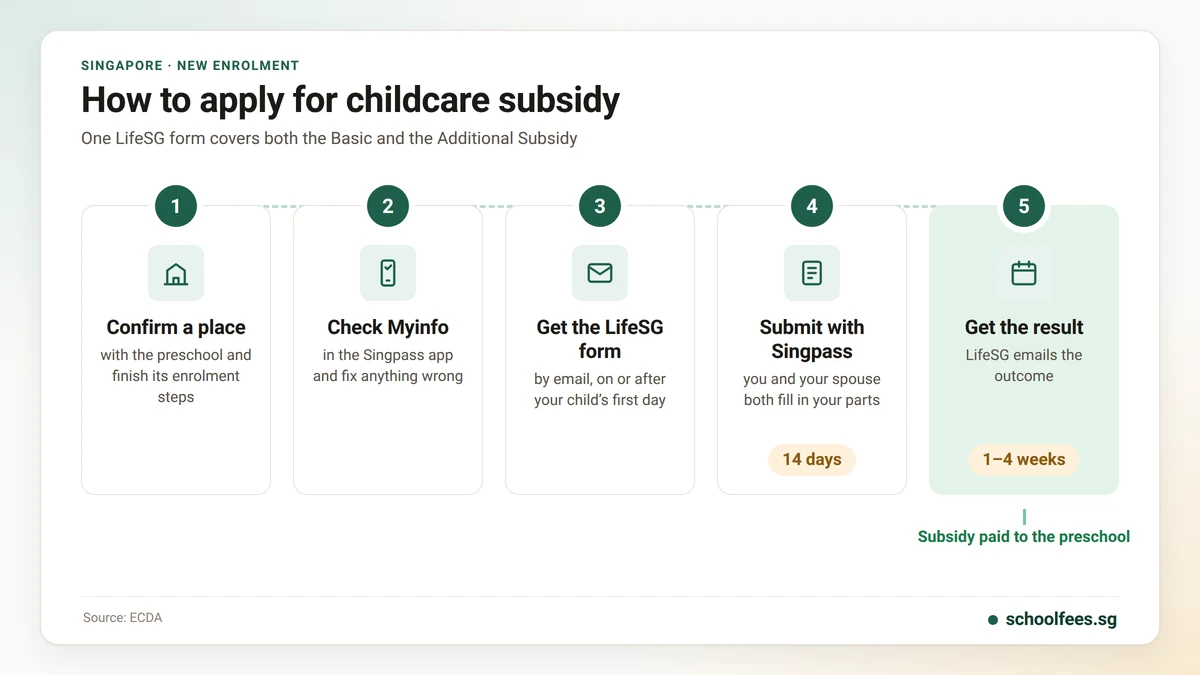
You apply for childcare or infant care subsidy after your child has a confirmed place, through a LifeSG form that the preschool sends you. One form covers both the Basic and the Additional Subsidy.
- Confirm a place with the preschool and complete its own enrolment steps, such as its form and deposit.
- Check your Myinfo details in the Singpass app, and ask the relevant agency to correct anything that is wrong.
- Watch for the LifeSG form. On or after your child's first day, the preschool triggers the form and you receive it by email. Ask the preschool if nothing arrives within the first week.
- Complete the form with Singpass within 14 days. You and your spouse both fill in your parts within 14 calendar days.
- Wait for the outcome. LifeSG confirms receipt by email and sends the result within 1 to 4 weeks. The subsidy is then paid straight to the preschool, so your monthly bill is already reduced.
Moving to another preschool counts as a new enrolment, so you apply again there.
Source: ECDA application for new enrolment (opens in a new tab)
What changes in 2027?#
From 1 January 2027, the household income limit for the Additional Subsidy rises from S$12,000 to S$15,000 a month, or S$3,400 per capita for households of five or more, and every income band covers higher incomes. The amount and co-payment in each band stay the same, so most working families move into a band with a bigger subsidy. The Basic Subsidy does not change, and the same shift applies to KiFAS. ECDA published the new tables on 6 October 2026, and MSF expects more than 60,000 families to benefit.
What are the new income bands from 2027?#
From 2027, each Additional Subsidy amount applies to a higher household income. Find your income in the "from 2027" column to see your new band:
| Childcare · infant care, up to | Income, until 2026 | Income, from 2027 | Per capita, from 2027 |
|---|---|---|---|
| S$467 · S$710 | S$3,000 or below | S$3,500 or below | S$750 or below |
| S$440 · S$640 | S$3,001 – 4,500 | S$3,501 – 5,500 | S$751 – 1,200 |
| S$340 · S$500 | S$4,501 – 6,000 | S$5,501 – 7,500 | S$1,201 – 1,700 |
| S$260 · S$380 | S$6,001 – 7,500 | S$7,501 – 9,000 | S$1,701 – 2,100 |
| S$190 · S$240 | S$7,501 – 9,000 | S$9,001 – 11,000 | S$2,101 – 2,600 |
| S$130 · S$100 | S$9,001 – 10,500 | S$11,001 – 13,000 | S$2,601 – 3,000 |
| S$80 · S$40 | S$10,501 – 12,000 | S$13,001 – 15,000 | S$3,001 – 3,400 |
| Basic only | Above S$12,000 | Above S$15,000 | Above S$3,400 |
Who qualifies for the first time in 2027?#
Three groups get income-tested help for the first time on 1 January 2027:
- working families earning S$12,001 to S$15,000 a month with a child in infant care or childcare, who today get only the Basic Subsidy
- households of five or more with a per capita income of S$3,001 to S$3,400
- families earning S$12,001 to S$15,000 with a child at an Anchor Operator or MOE kindergarten, who today get no KiFAS
How much less will families pay in 2027?#
At an Anchor Operator, a working family with a child in full-day childcare pays up to S$130 a month less from January 2027. The biggest drop is for households earning S$12,001 to S$13,000, who move from the Basic Subsidy alone into a band with S$130 of Additional Subsidy:
| Household income a month | You pay, 2026 | From 2027 | Change a month |
|---|---|---|---|
| S$3,500 | S$25 | S$3 | −S$22 |
| S$5,000 | S$58 | S$25 | −S$33 |
| S$7,000 | S$104.90 | S$58 | −S$46.90 |
| S$8,000 | S$174.90 | S$104.90 | −S$70 |
| S$10,000 | S$234.90 | S$174.90 | −S$60 |
| S$12,500 | S$364.90 | S$234.90 | −S$130 |
| S$14,000 | S$364.90 | S$315 | −S$49.90 |
| S$16,000 | S$364.90 | S$364.90 | no change |
This matches MSF's example of a household earning S$12,500 with two children at an Anchor Operator, whose bill for both falls from about S$730 to S$470 a month. ECDA has not said whether families already receiving a subsidy move to the new bands automatically, so if your household earns between S$12,001 and S$15,000, ask your preschool in December how the new rates will apply.
The 2027 change is separate from the fee cuts planned for 2028 to 2030, covered in will preschool be free?
Sources: ECDA subsidy tables, 2026 and 2027 (opens in a new tab), MSF COS 2026 (opens in a new tab), AsiaOne on the COS debate (opens in a new tab)
Frequently asked questions#
Do permanent residents get childcare subsidy?#
No. The Basic and Additional Subsidies are only for Singapore Citizen children, so permanent resident and foreign children pay the full fee, and many centres charge them more than citizens.
Does every preschool give the subsidy?#
Every ECDA-licensed infant care and childcare centre takes the subsidy, because it belongs to the child, not the centre. What differs is the fee: Anchor and Partner Operators have capped fees, so the same subsidy leaves you paying less there. Kindergartens are outside this scheme and use KiFAS instead.
Can I pay the rest from my Child Development Account?#
Yes. Money in your child's Child Development Account can pay the remaining fees, deposits and registration fees at approved preschools.
How long does an approved subsidy last?#
An approved subsidy lasts until the next fixed point of subsidy assessment set by ECDA, or until your child leaves. If your income, job or household changes before then, ask the preschool for a reassessment.
Does my child need to attend to get the subsidy?#
Yes. Your child must attend at least one day in a month for the subsidy to be paid for that month.
Sources: ECDA subsidy overview (opens in a new tab), MSF on the Child Development Account (opens in a new tab)
Sources#
- ECDA subsidy overview (opens in a new tab) ecda.gov.sg
- Made For Families (opens in a new tab) madeforfamilies.gov.sg
- ECDA subsidy tables (opens in a new tab) file.go.gov.sg
- MSF COS 2026 (opens in a new tab) msf.gov.sg
- ECDA application for new enrolment (opens in a new tab) ecda.gov.sg
- AsiaOne on the COS debate (opens in a new tab) asiaone.com
- MSF on the Child Development Account (opens in a new tab) ask.gov.sg
How we check this page#
Every rule on this page links to the ECDA, MSF or MOE page it came from, listed under Sources. The tables are not typed by hand: they are computed by the same code that works out the fee after subsidy on every centre page on schoolfees.sg, using ECDA's published rates in force from . This page was last checked on . We re-check it whenever ECDA or MSF announces a change, and at least every 90 days.