Preschool guide · Singapore
What to Expect at Preschool in Singapore: Holidays, Meals, Diapers and Teachers
What preschool looks like in Singapore depends on the type: childcare centres stay open almost all year and serve daily meals, while kindergartens run half days and follow school holidays. This guide answers the practical questions parents ask before the first day: holidays, meals, diapers, what to bring, and who the teachers are.
For short answers to 32 common questions, see the preschool in Singapore FAQ.
Do preschools have school holidays?#
It depends on the type of preschool. In Singapore, kindergartens follow MOE's primary school calendar, so they close in school holidays such as June and December. MOE Kindergarten fees are still payable in those months.
Infant care and childcare centres stay open all year except on:
- Sundays
- Public holidays
- Teachers' Day and Children's Day, which became preschool holidays in 2024
- Up to 6 Development Days a year, used for staff training and planning
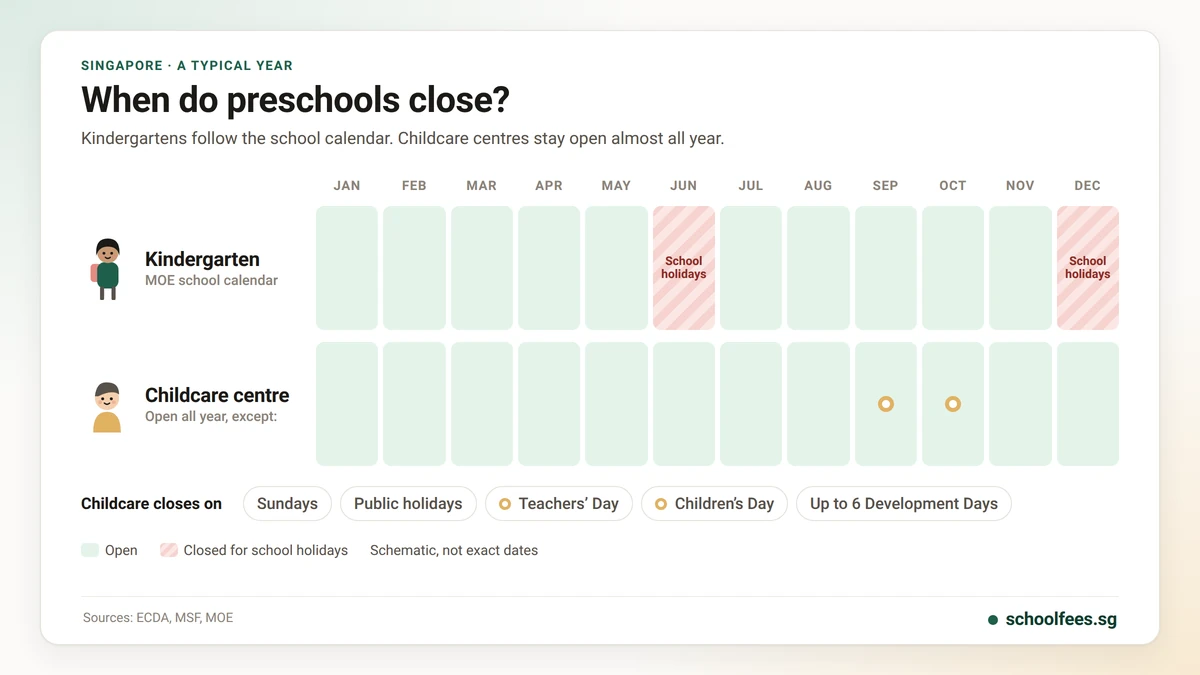
The fact that MOE kindergartens transition into full-day care environments during school holidays is why working parents often choose childcare over MK. The full difference is in preschool vs kindergarten vs childcare.
Sources: ECDA FAQ (opens in a new tab), MSF on Development Days (opens in a new tab), MOE fees (opens in a new tab)
Do preschool children get free meals?#
Singapore has no separate free-meals scheme for preschool children. Instead, full-day infant care and childcare centres serve meals every day, such as breakfast, lunch and afternoon tea, and these are usually part of the monthly fee. Half-day programmes usually give a short snack break.
ECDA sets food rules for all preschools:
- Meals include wholegrains, lean protein and vegetables.
- Children in programmes longer than 6 hours get fruit every day.
- Deep-fried food, preserved meats and sugary drinks are not allowed.
- Drinking water must be available at all times.
Sources: ECDA meal requirements (opens in a new tab), ECDA Code of Practice (opens in a new tab), PCF Sparkletots FAQ (opens in a new tab)
Do preschool teachers change diapers?#
Yes, for younger children. In Singapore, changing diapers and helping with toilet training are part of the daily care in infant care and toddler classes. ECDA's rules require infant care centres to have proper diaper-changing tables with sinks nearby. Parents usually supply the diapers and wipes.
Children learn to use the toilet at different ages: some are ready at 18 months and others closer to 4 years. Ask each centre about its toilet-training approach for older levels.
Sources: ECDA Code of Practice (opens in a new tab), ECDA Grow@Beanstalk (opens in a new tab)
Does preschool have a school supply list?#
Usually not a long one. Singapore preschools normally provide the learning materials, often through a materials fee instead of a supply list. Parents usually provide personal items:
- Uniforms (PCF Sparkletots suggests buying at least 2 sets to start)
- Spare clothes
- A named water bottle
- Diapers and wipes for younger children
Many centres also charge one-time fees for things like registration, a deposit, insurance and uniforms. Ask for the full list when you enrol, and see how much preschool costs for typical amounts.
Do preschool teachers need to be certified?#
Yes. In Singapore, teachers in ECDA-licensed preschools must hold recognised qualifications and be certified by ECDA. The basic qualification for teaching children aged 18 months to 6 years is a Diploma in Early Childhood Care and Education – Teaching (DECCE-T) or an equivalent.
Educators of babies and toddlers take courses such as the Higher Certificate in Infant Care (for ages 2 to 18 months) or the Advanced Certificate in Early Years (for ages 2 to 36 months). Every staff member, including outside enrichment trainers, needs ECDA approval.
ECDA also sets the minimum number of qualified staff for each class:
| Level | Minimum staff-to-child ratio |
|---|---|
| Infant (18 months and below) | 1 : 5 |
| Playgroup (18 months to below 3 years) | 1 : 8 |
| Pre-Nursery (N1) | 1 : 12 |
| Nursery (N2) | 1 : 15 |
| Kindergarten 1 | 1 : 20 |
| Kindergarten 2 | 1 : 25 |
Sources: ECDA educator training (opens in a new tab), NTUC First Campus (opens in a new tab), ECDA Code of Practice (opens in a new tab), ECDA on the ECDC Act (opens in a new tab), ECDA ratios (opens in a new tab)
Summary#
- Kindergartens close in school holidays; childcare centres close only on Sundays, public holidays, Teachers' Day, Children's Day and up to 6 Development Days.
- Full-day centres serve daily meals that follow ECDA's food rules; there is no separate free-meals scheme.
- Educators in infant and toddler classes change diapers and help with toilet training.
- Preschool teachers in Singapore must be certified by ECDA.
How we check this guide#
Every figure on this page links to the government page it came from, shown under each answer. The guide was last checked against those sources on . We re-check it whenever ECDA, MOE or MSF announces a change, and at least every 90 days.